Machine Learning
Document‑Aware Conversational AI API
RAG Backend is a purpose-built API that converts unstructured documents into a searchable, conversational knowledge layer so applications can deliver accurate, context-aware answers. It addresses a common shortcoming of large language models, susceptibility to hallucination and lack of source grounding — by combining document ingestion, embedding generation, and fast vector retrieval so the model answers with relevant context and verifiable sources.
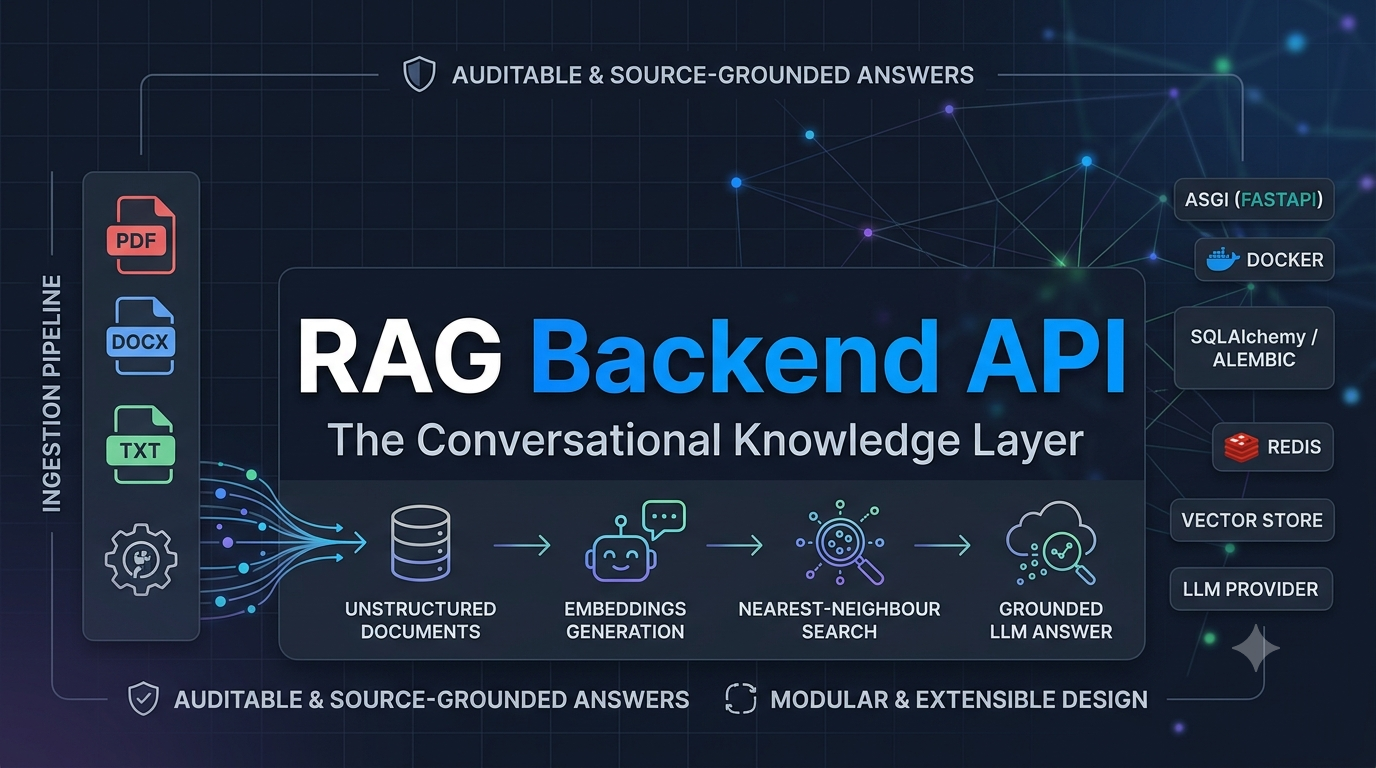
Under the hood the service is an ASGI application with clearly separated concerns: ingestion pipelines parse and preprocess documents, an embedding layer turns text into vectors, a retrieval layer performs nearest-neighbour search, and SQL + Redis manage persistence and session state. The codebase favors modularity and reproducibility — handlers live under app/api/v1/endpoints, database models and migrations are managed via SQLAlchemy and Alembic, Redis provides caching and lightweight state, and Docker/docker‑compose make deployments repeatable. These choices make it straightforward to swap vector stores, switch LLM providers, or run the whole stack in a VPC for data-sensitive deployments.
From a commercialization perspective, the product is positioned for teams that need reliable, auditable answers from their corpus: customer support automation, internal knowledge assistants, and regulated industries where traceability matters. The architecture supports multiple go‑to‑market models — SaaS subscriptions with usage tiers, enterprise on‑prem installs with SLAs, or a managed offering — and the platform’s emphasis on source-backed responses and modular integrations reduces engineering friction for customers integrating into CRMs, ticketing systems, or internal tools.
I implemented the ingestion and retrieval pipelines, integrated persistence and caching layers, and containerized the application for production-ready deployment, focusing on reliability and observability. Working on this project reinforced lessons about building for extensibility (so components can be replaced without large rewrites), the importance of end-to-end tests for data pipelines, and designing APIs that make it easy for product teams to consume contextual responses.